Antek’s alienation from the village
The PeasantsAntek Boryna’s alienation from the village is a state of chosen withdrawal and painful exclusion, driven by concealed desire, simmering anger, and the effort to keep his feelings under control. Outwardly he becomes a quiet, diligent husband and worker; inwardly he remains intensely distressed, avoiding people and even the familiar routes through Lipce. The distance between his public composure and private turmoil makes his isolation more than simple solitude: it is a life lived at the village’s edge while still yearning for the fellowship he denies himself.
Origins in rivalry and concealed desire
The strain is already visible in Antek Boryna’s worsening relations with Mateusz. Both men have pursued Jagna since before spring, perhaps since Shrovetide, and each knows the other is a rival. Mateusz speaks openly of his affections, while Antek has to conceal his; that imbalance feeds an envy that burns beneath his restraint. Their hostility, once expressed through wary looks and provocations in front of others, escalates until they pass one another without greeting, like enraged wolves.
The rivalry also shapes Antek’s position at work. Mateusz can taunt him and boast that Antek works for him and obeys him, while Antek believes Mateusz is waiting for an excuse to dismiss him. He checks his temper rather than risk losing his employment, but stores up the insults and sees through Mateusz’s performance. Their conflict therefore narrows Antek’s social world from two directions: Jagna is the concealed source of their antagonism, while the workplace makes him endure the rival’s authority in public. The restraint that protects his livelihood does not dissolve the anger; it forces him to carry it alone.
Work, domestic calm, and hidden distress
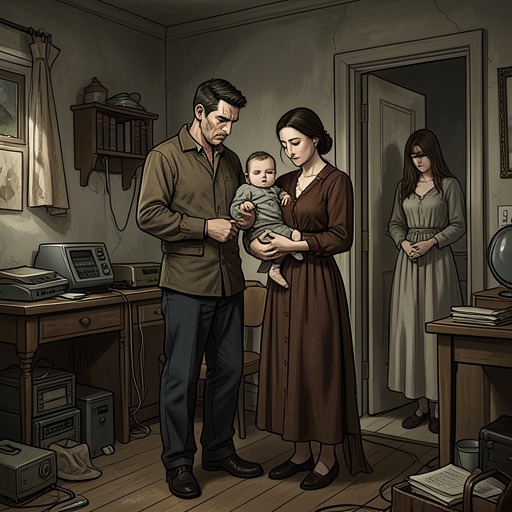
Antek’s retreat does not initially appear as idleness or open rebellion. He works week after week, hands every last grosz to Hanka Borynowa, returns home in the evening, helps with the farm, and plays with the children. He has little interest in the raise itself; he works because he has taken to the labor, moving through it with the unquestioning regularity of a horse in harness. To the village, he can seem to have become quieter and more compliant, as if he had forgotten his injuries.
That visible calm does not reassure Hanka Borynowa. She welcomes the change, thanks God for it, and attends closely to her husband, trying to anticipate what he needs. Yet she repeatedly sees sadness in his expression and hears quiet sighs. She senses that something terrible remains held inside him and fears the force of what he is containing. Her attentiveness brings the contrast into focus: domestic cooperation has returned, but emotional confidence has not. Antek’s silence lets him function within the household while leaving his suffering inaccessible to the person caring for him.
The narrator likens his inward state to deep water trapped beneath ice: snow covers the surface, but the water continues to murmur until the frozen shell may break. Antek’s apparent composure is thus not a resolution but a lid on pressure. His self-command becomes an iron harness for his own soul, and maintaining it costs him more as time passes. The work and household routine occupy his days, but neither releases the grief that has settled beneath them.
Avoidance, surveillance, and the village boundary
His withdrawal takes practical form in his movements. At dawn, when the rorate bells ring, Antek passes the lit church and pauses outside to listen to the organ and the voices. The music reaches him through the winter morning, but he quickly hurries on, unwilling to be seen listening or to appear absorbed. He takes the longer way around the pond to avoid passing his father’s house and meeting anyone. The detour turns an ordinary walk into a repeated act of evasion: even when he is drawn toward communal sound, he makes himself disappear from view.
On Sundays, he refuses Hanka Borynowa’s pleas to accompany her to church. His reason is specific: he is afraid of meeting Jagna and knows he could not bear the encounter. Avoidance here is not indifference to the village or its rituals. He still pauses to hear church music, and his fear of seeing Jagna reveals how powerfully the attachment continues to shape him. The places and occasions that might return him to shared life instead become situations he must evade.
Antek also feels that people are watching him. Through Bartek, with whom he is on friendly terms, and through his own observations, he knows the village remains preoccupied with him. He notices faces peering around corners and curious glances following his movements, which seem to search his soul for hidden thoughts. The text presents this scrutiny as something he keenly experiences; it pains him and intensifies his conviction that people have turned against him. He answers the imagined scrutiny by becoming more obstinate in his anger and avoiding others still further. Withdrawal and suspicion thus reinforce each other: the more he stays apart, the more hostile the village appears, and the more hostile it appears, the less willing he is to return.
The alien-bird image and unresolved ending
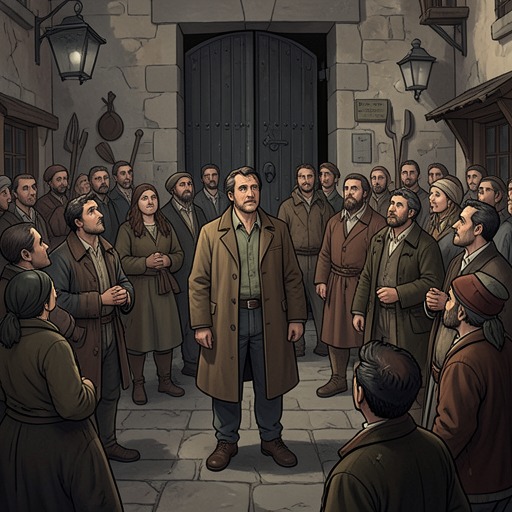
The narration sets Antek apart from the varied, noisy life of the community. Around him, neighbors endure poverty, celebrate with friends, pursue girls, nurse illness, or rest by warm stoves; each lives with a whole heart and soul. Against that collective bustle, Antek alone seems cut off from the villagers. He is likened to a timid, hungry alien bird flapping outside lamp-lit windows. It longs for company and looks toward full hayricks, yet will not fly inside. Instead, it circles, watches, and feeds on its own torment and yearning.
The image gathers together the contradictions of his condition. Antek is not free of attachment: he is hungry for fellowship, drawn to music, and still affected by Jagna. But longing does not overcome fear, shame, or anger. He describes himself as scarcely able to manage his own company, and the narrative gives that isolation a physical weight: his soul tires under its restraints, sadness tears at him, and life itself becomes repellent. His estrangement is therefore neither a clean separation from the village nor a settled independence. It is an inward confinement maintained by a man who continues to circle the life he cannot bring himself to enter.
At Yuletide, the apparent quiet still has no resolution. Antek’s work, dutiful household behavior, and avoidance of neighbors remain outward signs of self-control, while the narrative insists that his pain persists beneath them. He longs for a transformation that would alter his circumstances once and for all, yet remains afraid even to think about it. The ending leaves him suspended between endurance and change: physically among the people of Lipce, emotionally apart from them, and unable either to surrender his yearning or to act on the hope that might release him.